
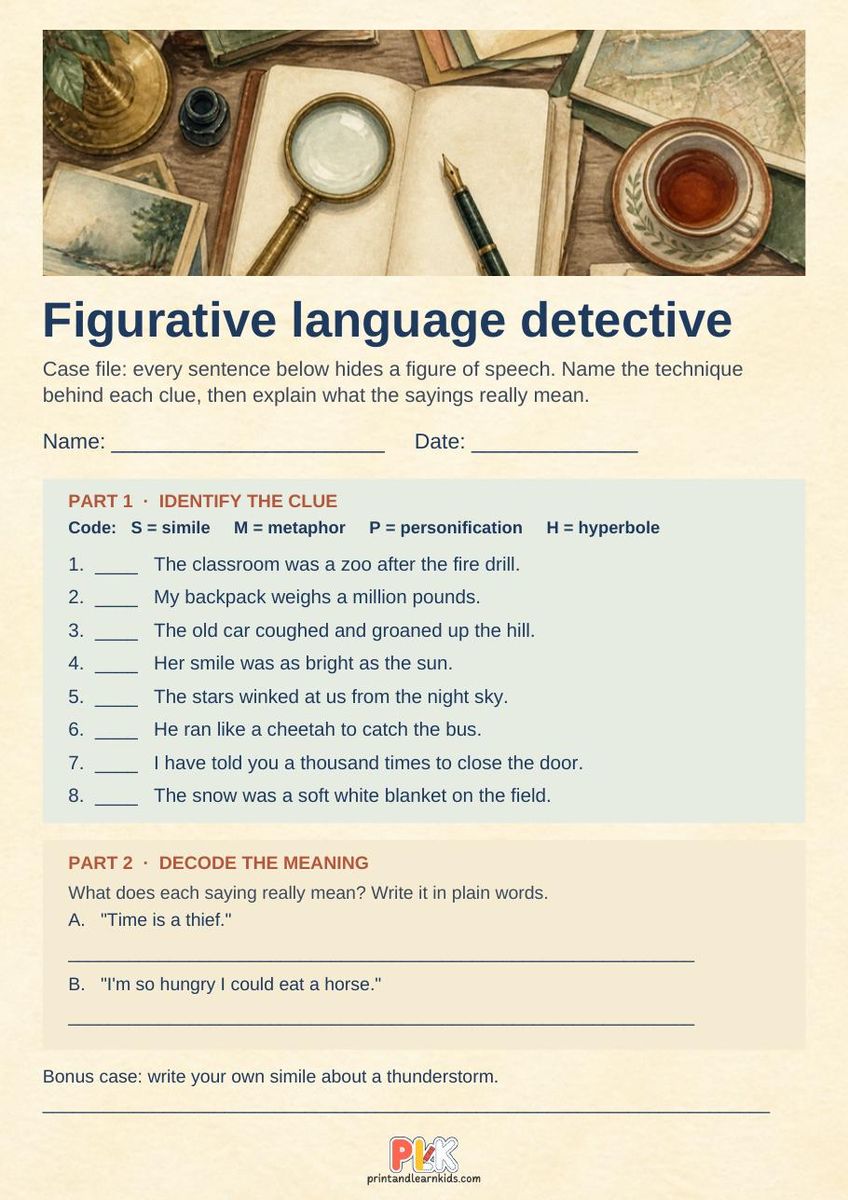
Figurative Language Detective
A detective-themed Grade 4 language page with a watercolor case-file header. Children identify similes, metaphors, personification and hyperbole in eight sentences, explain what two common sayings really mean, and write their own simile. Clean activity-book layout with navy, sage and terracotta panels.
How to use this worksheet
- Part 1: read each of the 8 sentences and write S, M, P or H to show the figure of speech.
- Part 2: explain in plain words what the two sayings really mean.
- Bonus: write your own simile about a thunderstorm.
What your child practices
Recognizing and explaining figurative language, a Grade 4 reading standard in the US: knowing that writers say things that are not literally true to create a picture or feeling. Answers: 1 M, 2 H, 3 P, 4 S, 5 P, 6 S, 7 H, 8 M. Part 2: A) time passes quickly and takes moments away before we notice; B) I am very hungry. Any simile using like or as works for the bonus, such as "the thunder boomed like a drum."
Who it is for
Made for fourth graders around nine to ten. It also works for confident third graders or as a quick review in Grade 5. If your child mixes up simile and metaphor, have them circle every "like" and "as" first.
Spot it in real life
Figurative language is everywhere in song lyrics, ads and sports commentary. Challenge your child to catch one of each type during a week of reading or listening, and keep a list on the fridge.